

Why is this important?
If you want communication that builds alignment instead of defensiveness and moves teams and relationships forward with purpose, this is the model that deeply improves relationships.
Why Conscious Conversations Matter Right Now
The hardest communication breakdowns aren’t because people aren’t smart.
They’re because leaders and teams are often reacting on autopilot they speak without noticing what’s happening in their bodies and their minds. That’s unconscious communication, basically a lack of emotional intelligence.
Conscious conversations change that.
With this approach:
- You pay attention to what’s said and unsaid
- You slow reaction patterns with deep breaths
- You read body language instead of assuming
- You defuse tension instead of escalating it
This isn’t “nice to have.” This is how leaders earn real buy-in and sustain teams that work well together long-term.
What a Conscious Conversation Is (and Isn’t)
| Conscious conversation is: | Conscious conversation is not: |
|---|---|
| ✔ Intentional | ❌ A passive agreement |
| ✔ Attuned | ❌ “Just talking it out” generically |
| ✔ Regulated | ❌ Avoiding conflict |
| ✔ Inclusive |
It’s all about how to stay present with yourself and others.
Your Framework: The 6-Prong Conscious Conversations® Model
At the heart of how I teach conscious communication is a 6-prong framework that gives leaders structure and confidence under pressure. These aren’t buzzwords—they’re applied behaviors you can use today.
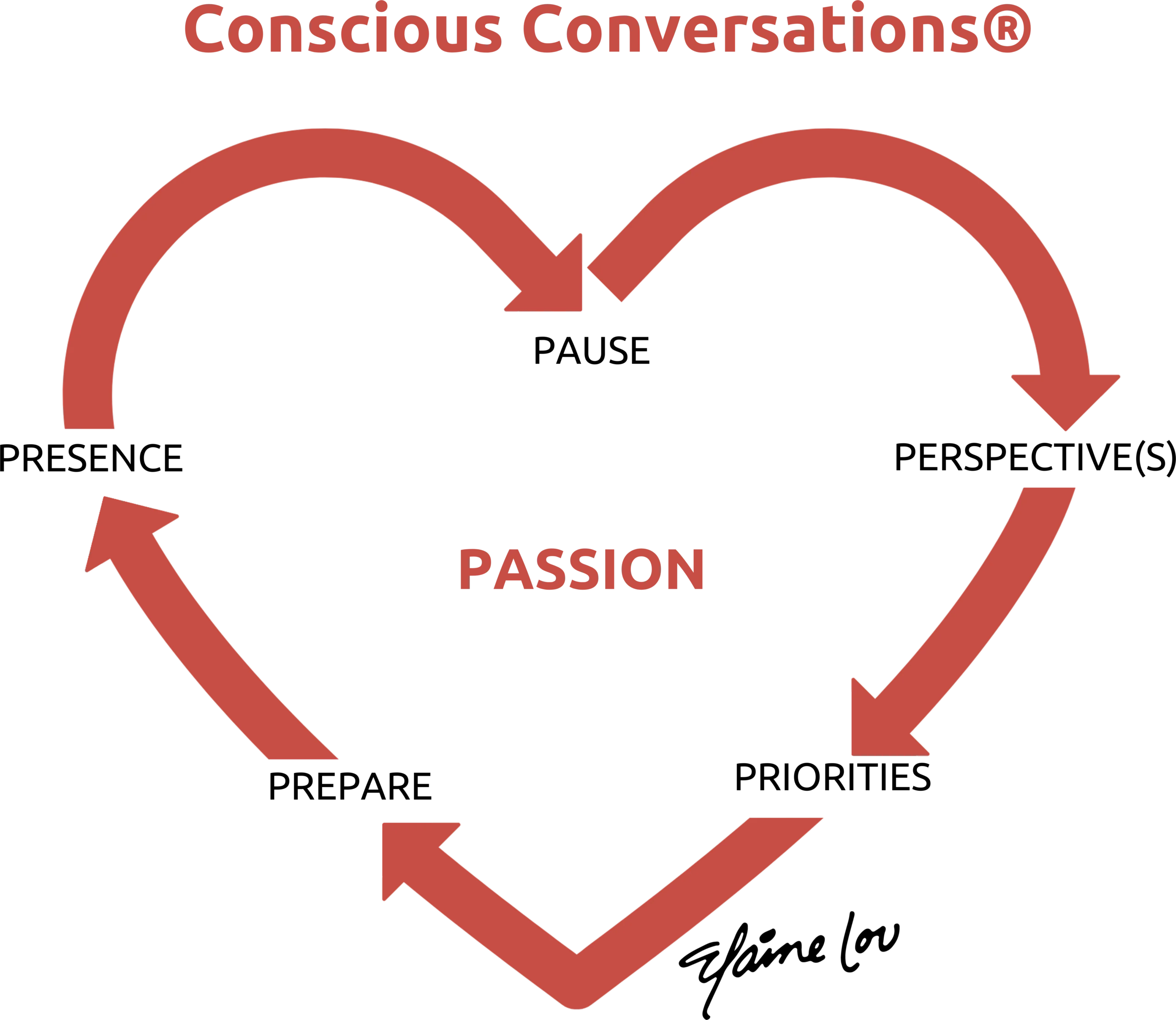
6 Pillars of Strategic Communication
| Pillar | What You Do | Why It Matters |
|---|---|---|
| Pause | Take deep breaths; slow your thinking before responding | Regulates nervous system so you make intentional choices |
| Perspective(s) | Seek others’ goals and styles | Helps everyone feel seen and reduces misinterpretation |
| Priorities | Clarify what matters most for each person | Aligns focus instead of diffusing effort |
| Prepare | Strategize your approach ahead of time | Prevents reactivity and makes communication deliberate |
| Presence | Speak and lead with confidence | Ensures your presence supports the outcome |
| Passion | Connect back to purpose | Reinforces motivation and keeps conversations constructive |
This model bridges internal experience and external expression. It makes communication measurable, not muddled.
So what looks like simple intentions—like pausing or checking priorities—is actually strategic action that shifts outcomes.
Conscious vs. Unconscious Communication
Don’t mistake volume for engagement. A lot of communication happens below awareness.
Unconscious communication is when your reactions are automatic when your tone, breath, or defensiveness speaks louder than your words.
With a conscious conversation:
- You pay attention to your impulses
- You slow your breath instead of accelerating reactive tension
- You notice your body language: shoulders, eye contact, gesture
- You read others instead of just waiting to speak
This is how you move from noise to impact.
A Leader’s Reality: How this Shows Up (Real, Not Theory)
Imagine a team meeting where:
- People actually listen instead of preparing a rebuttal
- Managers say what they mean without apology
- Teams resolve conflict in minutes instead of days
That’s not hypothetical, that’s what happens when teams use structured conscious communication scripts and practices. It’s leadership that lands.
Your Credentials + the Authority Behind the Model
Why trust this framework? Because it’s not theoretical:
- I’m a Professional Certified Coach (PCC) through the International Coaching Federation.
- I’m a trauma-informed coach which means I understand how stress impacts communication.
- I’ve worked with 20,000+ clients in 58 countries.
- My Conscious Conversations® model earned me #1 Thought Leader honors from LA Weekly.
- My work is featured in Forbes, Business Insider, Money, and HuffPost.
- I have courses with LinkedIn, Penn, Brown, Duke, Johns Hopkins, USC and more.
This is tested at scale, not just taught in workshops.
How to Begin Practicing Conscious Conversations Today
Here’s the action plan you can start using immediately:
- Pause before responding — calm your breath, reset your nervous system.
- Ask what matters here — not just what was said.
- Check body language — yours and theirs.
- State priorities out loud — so nothing is assumed.
- Clarify commitments before closing — avoid ambiguity.
FAQs — Quick Answers Leaders Actually Ask
Isn’t this just effective communication?
Is this helpful in conflict or high-stakes moments?
Yes, especially there. Conscious systems reduce stress reactions and create psychological safety so real issues can be addressed directly.
Do teams really need training for this?
Yes, unintentional communication costs time, trust, and alignment. This framework makes communication predictable and reliable.
Final Thought
Communication isn’t just what you say: it’s what you hold, what you notice, and how you respond when it’s hard.
When you pay attention to all of that with breath, body, and intention you unlock confidence, clarity, and collaboration.
Ready to Strengthen Communication Across Your Team?
→ Book a Conscious Conversations® strategy session
→ Bring this framework to your leadership cohort
→ Start with a leadership communication audit
Lead with awareness.
Communicate with intention.
Build relationships that last.